
Shopping weather
What rain does to sales: an index built from weather and season.
May was weak. Was it the weather – or us? In garden and seasonal retail this question comes up every spring, and mostly it stays an opinion. Pythia is meant to turn it into a measurement.
Weather as a data source
First you need weather data, in a form that fits the business. For every day Pythia stores temperature, sunshine, rain and wind – as actuals and as a forecast for the next 16 days. These series can be shown on the timeline: actuals as solid lines, forecasts dashed.
“Germany” is not a single measuring point. Pythia forms a weighted average of 19 regions – the 16 federal states and three neighbouring countries – weighted by population and purchasing power. A summer day in a densely populated region therefore counts for more than one in a sparsely populated one. Set a country filter and the weather follows it.
The shopping-weather index
Weather on its own says nothing yet. What matters is what it does to buying behaviour – and that differs by range. Heat drives pools and parasols but may slow down lawnmowers. So Pythia measures the relationship per cluster.
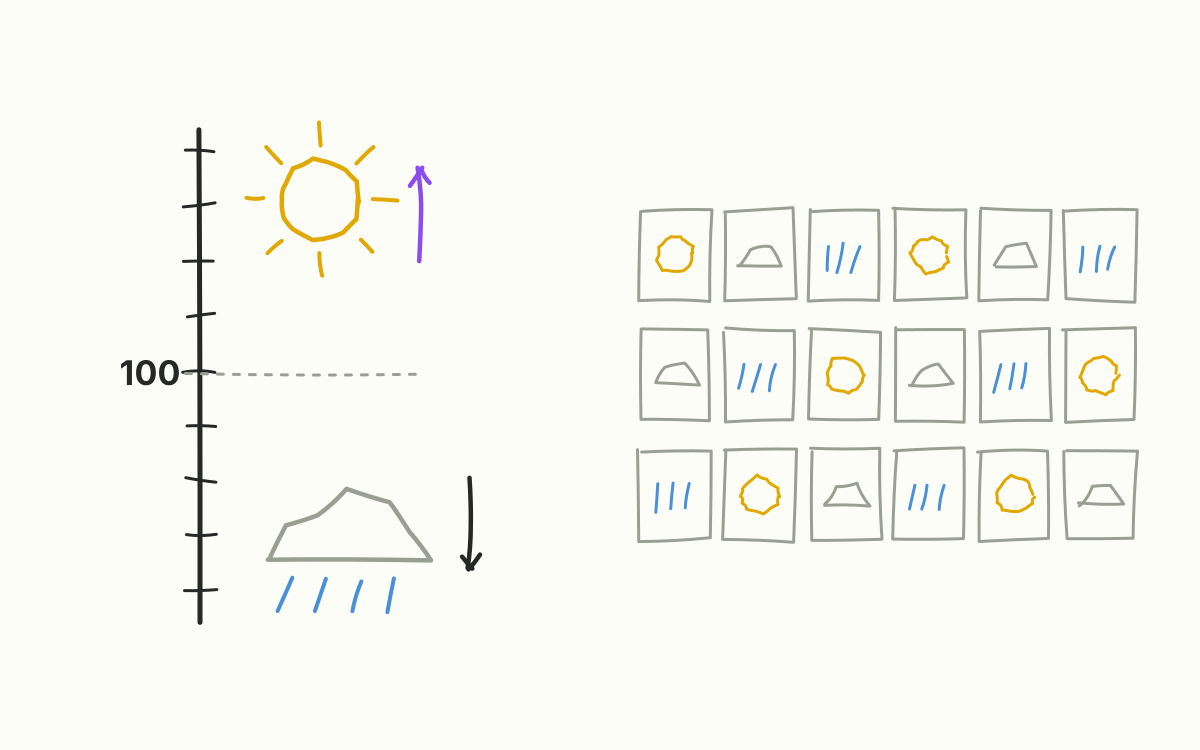
The result is the shopping-weather index: 100 means normal for the season. Above that, weather of this kind has brought more revenue in the past than expected for the time of year; below it, less. Because weather forecasts exist, the index also reaches into the coming days.
Weather explains a measurable but small part of the fluctuation. That is less than people like to believe in spring – and exactly why it is worth measuring.
Honestly calculated
An index that flatters its own data is worthless. So Pythia tests the shopping-weather index by leaving a year out: it is calculated without one year and must prove itself on exactly that year. If there are too few days for a weather situation, the overall value applies; if there is too little data for a range, that range simply gets no index.
A dedicated page shows the weather classes, their factors and the test per year. The index can be recalibrated at the push of a button when new data has come in.
What is still to come
Today the shopping-weather index is a layer of its own next to the expectation. Having it correct the expectation on the candle directly is planned but not yet built – as are an index per federal state and better handling of extremely hot days.
Next month: consumer climate, ifo, inflation – and whether they really explain anything.